The Consolidated Account Statement, commonly known as CAS, is one of the most important documents you will receive as an investor in India. It provides a comprehensive snapshot of all your financial holdings — Demat securities, mutual fund units, and transaction history — across depositories and fund houses in a single report. Yet many investors receive the CAS every month and either ignore it or find it too complex to interpret. Learning to read and use your CAS effectively is one of the most valuable habits you can develop as an investor.
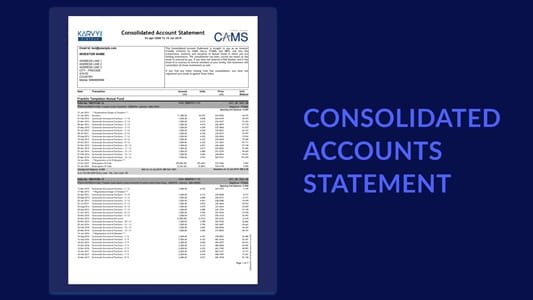
What is a Consolidated Account Statement?
The CAS is a unified statement issued by the depositories — NSDL and CDSL — and the Registrar and Transfer Agents — CAMS and KFintech — that consolidates all your investment holdings in one document. It covers equity shares held in your Demat account, mutual fund units held both in statement form and Demat form, and all transactions executed during the reporting period.
SEBI mandated the issuance of the CAS to simplify portfolio tracking and reduce the confusion of managing separate statements from multiple fund houses and brokers. The CAS is issued monthly if there has been any transaction in your accounts during that month, and on a half-yearly basis even if there are no transactions.
How to Receive Your CAS
The CAS is sent automatically to your registered email address by NSDL or CDSL. You can also download it on demand by visiting the NSDL CAS portal or the CDSL EASI portal and requesting a statement for a specific period. The CAS is typically sent as a password-protected PDF. The password is usually a combination of your PAN and date of birth in a format specified in the email accompanying the statement.
Structure of the CAS
The CAS is organized into several clearly defined sections:
- Investor Details: Your personal information including name, PAN, address, registered email, and mobile number
- Demat Holdings: A complete list of all equity shares, bonds, ETFs, and other securities held in your Demat account as on the statement date, including the ISIN, security name, quantity, and market value
- Mutual Fund Holdings: All mutual fund units held in your folios across AMCs, including scheme name, folio number, plan type, number of units, NAV, and current value
- Transaction Summary: A chronological list of all buy, sell, dividend, and other transactions during the reporting period
- Portfolio Valuation: The total market value of all your holdings as on the statement date
How to Read the Demat Holdings Section
The Demat holdings section lists each security you hold with its ISIN code, the quantity held, the current market price, and the total market value. Check this section carefully to verify that all your holdings are correctly reflected. If you notice any discrepancy — a missing security or an incorrect quantity — contact your DP immediately for investigation.
How to Read the Mutual Fund Holdings Section
The mutual fund section shows each scheme you are invested in with the folio number, number of units, current NAV, and total value. This section is particularly useful for identifying duplicate folios, checking the current value of each fund, and reviewing your overall asset allocation across equity, debt, and hybrid funds.
Using CAS for Portfolio Review
Your CAS is an excellent tool for conducting a comprehensive annual portfolio review. By comparing consecutive CAS statements, you can track the growth of your portfolio over time, identify underperforming funds, assess your current asset allocation against your target allocation, and ensure that all transactions have been correctly processed. Any discrepancy between your records and the CAS should be investigated promptly.
FAQs
Q. How often is the CAS generated?
The CAS is generated monthly if there has been at least one transaction in any of your investment accounts during that month. If there are no transactions, a half-yearly CAS is sent in September and March covering the respective six-month periods.
Q. What is the password to open the CAS PDF?
The CAS PDF is typically password protected. The password is usually your PAN in lowercase letters followed by your date of birth in DDMMYYYY format. The specific format is mentioned in the email accompanying the CAS.
Q. Why are some of my mutual fund holdings not showing in the CAS?
If some mutual fund holdings are not reflected in the CAS, it may be because your PAN is not linked to those folios, or the folios are registered with a different email address. Update your PAN and email across all folios to ensure complete consolidation in the CAS.
Q. Can I use the CAS as proof of investment for loan applications?
Yes. The CAS is a widely accepted document for proving investment holdings for loan applications, financial planning purposes, and KYC submissions. Many banks and financial institutions accept a recent CAS as evidence of your investment portfolio.
Q. Is the CAS available for investments held in physical certificate form?
No. The CAS only covers dematerialized securities held in a Demat account and mutual fund units held in electronic form. Physical share certificates are not reflected in the CAS and must be tracked separately until they are dematerialized.