There’s a quiet architectural revolution underway in Indian residential design, and it has to do with walls, specifically, the growing sense that we’ve been building too many of them. Where a solid facade once seemed the natural default, today’s architects are asking a different question: how much of this wall can actually be glass?
The answer, increasingly, is: quite a lot. From premium apartment towers in South Mumbai to independent homes across Bengaluru and Pune, the visual barrier between inside and outside is being reduced in favour of larger, cleaner, more elegantly framed openings. This isn’t stylistic experimentation. It reflects a considered response to how people want to live now, connected to light, connected to view, and connected to the world beyond their four walls.
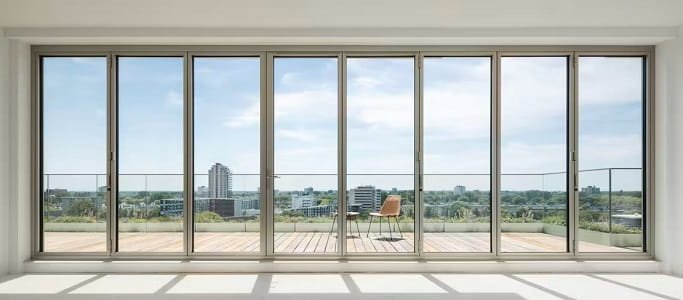
The Design Philosophy Driving the Shift
The move toward large glass windows is rooted in something older than contemporary taste. It reflects a growing appreciation, supported by research in environmental psychology and health science, that humans are affected in measurable ways by their exposure to natural light and their connection to outdoor views.
Biophilic design, the architectural philosophy that formalises this understanding, has moved from academic circles into mainstream practice over the past decade. Its central insight is straightforward: we thrive when our built environments maintain some continuity with the natural world, and we suffer, in small but cumulative ways, when they don’t. Large glass windows are among the most direct architectural responses to this insight.
In India specifically, this philosophy has deep cultural resonance. Traditional Indian domestic architecture the courtyard house, the veranda, the jaali screen, was never really about enclosure. It was about mediating between inside and outside in ways that let both coexist. Contemporary large glass windows are, in many ways, a modern translation of that ancient sensibility, using materials and engineering that earlier generations simply didn’t have access to.
How Slim Aluminium Frames Made This Possible
The aspiration for expansive glazing is not new. What’s new is the engineering that makes it visually clean and structurally sound. And the enabling technology is the aluminium-framed window built on high-performance alloys with genuinely slim profiles.
For decades, the trade-off in window design was frustrating: bigger glass meant stronger, heavier frames, which meant more visible frame material, which undermined the transparency that motivated the larger glass in the first place. Modern aluminium glass windows have resolved this through materials science. Duranium, the proprietary alloy developed by Hindalco for Eternia’s systems, is 40% stronger than standard aluminium, which allows sightlines to be reduced to as little as 20mm in premium systems.
The visual difference this creates matters more than the numbers suggest. Across a wide living room facade, the choice between a 20mm sightline and a 60mm one changes the entire character of the wall. The former reads as glass with a suggestion of frame; the latter reads as a grid of frames with glass in between. This is why architects specify premium aluminium windows rather than standard systems whenever the visual result really matters.
Designing Large Windows for Living Rooms
When architects design living rooms with expansive glazing as the centrepiece, they work across several dimensions at once: structural, environmental, aesthetic, and experiential. Understanding this process helps homeowners appreciate what goes into a well-considered glass window design for home interiors.
The first consideration is orientation. Not all facades suit large glazing equally. South-facing walls receive intense sunlight in India and require careful management of solar heat gain through glass specification. East and west orientations offer atmospheric morning and evening light but demand attention to glare. North-facing rooms enjoy consistent, soft daylight, often the easiest to design around when large glass is the goal.
The second consideration is composition. Very few architects treat a large glazed wall as a single undifferentiated element. The best glass window designs work through layering, combining fixed panels with operable sections, varying heights and proportions, creating a facade that reads as composed rather than blank. Eternia’s range of typologies, across the Duraslim and Essentials series, gives architects the vocabulary to construct these facades with precision.
The third consideration is what lies beyond. A large glass window facing a beautiful garden or a treetop canopy is an obvious asset. But even less spectacular external environments can be made to work through thoughtful foreground planting, framed views, or careful orientation. The glass is only ever half the design; what it opens onto is the other half.
Balancing Openness with Indian Realities
The aspiration for large glass windows in Indian homes runs counter to specific challenges that make thoughtful specification essential rather than optional. India’s climate, urban density, and monsoon conditions place demands on aluminium glass windows that differ meaningfully from the European contexts in which many contemporary design ideas were developed.
Solar heat gain is the most immediate concern. Large glazed facades can create significant heat gain if the glass is not properly specified. This is not a reason to avoid large windows; it’s a reason to specify the right glass. Double-glazed units with insulating air layers, tinted glass for solar control, and low-emissivity coatings all reduce heat gain while maintaining light transmission.
Monsoon performance is equally critical. Large glass windows in coastal cities or high-rise apartments must resist wind-driven rain without allowing water ingress. This is where independent performance certification becomes non-negotiable. Eternia’s WiWA-certified systems test rigorously for wind resistance, water tightness, and air sealing, providing the assurance that expansive glazing will perform reliably across India’s most demanding conditions.
Acoustic management in urban environments is a third consideration. Large glass surfaces can conduct noise as easily as they admit light. Acoustic laminated glass and high-quality frame sealing address this without compromising the transparency that motivates the design in the first place.
Conclusion
The architectural movement toward large glass windows is not a stylistic experiment. It is a considered response to what we now understand about how humans thrive in built environments. Light matters. Connection to the outdoors matters. The sense of spatial generosity that comes from walls of glass matters in ways that are measurable, replicable, and deeply felt.
The engineering that makes this vision achievable, premium aluminium windows built on advanced alloys, with certified weather performance and slim sightlines has advanced to the point where the gap between aspiration and reality is genuinely narrow. For Indian homeowners working with architects on new builds or renovations, the opportunity to embrace this direction has never been better supported by the products available.
The wall, as the default, is giving way. What replaces it is something considerably more interesting.