Sentimentality about brand loyalty has no place in a professional kitchen. A chef will replace a supplier without much ceremony if the product stops performing consistently. That lack of attachment makes professional preferences a useful signal for evaluating spice brands — they have no reason to favour one product except that it works in the pan and holds up under busy-kitchen conditions, a different standard from a retail consumer’s experience.
Before a spice alters the flavour of a dish, a cook tests its “bloom” in hot oil. A home cook might use a chilli powder twice a week; a restaurant kitchen might go through the same quantity in a single service. Any inconsistency in heat, grind, or moisture shows up quickly and repeatedly at that frequency — which is why professional cooks almost always come back to consistency and shelf behaviour first.
The Brands That Show Up in Commercial Kitchens
A handful of names come up repeatedly when institutional buyers — restaurant chains, catering operations, hotel kitchens — are asked which are best spice brands that they actually use, each for slightly different reasons.
MDH, founded in 1919, remains one of the most widely distributed spice brands in the country, with a network spanning over 400,000 dealers. Its scale and batch-to-batch consistency make it a dependable default for high-volume blends like garam masala.
Everest, in the market since 1967, built its institutional reputation on biryani and pav bhaji masalas, and its export footprint across roughly 80 countries reflects the quality-control discipline commercial kitchens tend to trust.
Badshah Masala has particular strength in bold, punchy blends suited to street-food-style, high-turnover restaurant cooking, and shows up frequently among institutional suppliers alongside the bigger national names.
Aachi and other South Indian-focused suppliers like Synthite hold a strong position with kitchens cooking South Indian and Southeast Asian menus, where northern-focused majors don’t always translate well.
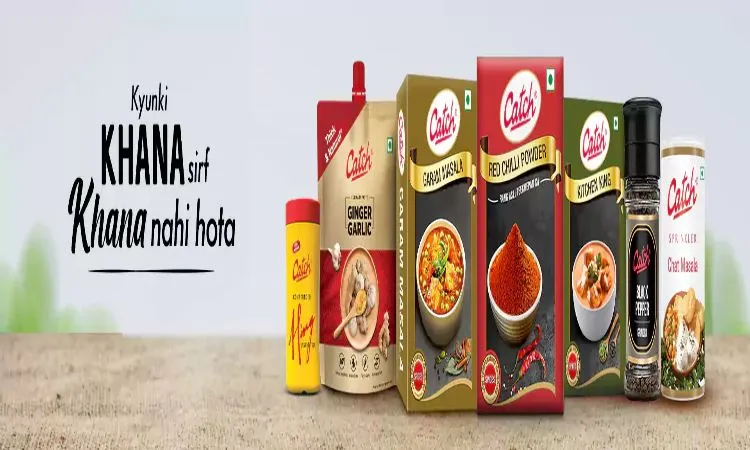
Catch, part of DS Group’s food and beverage portfolio, stands out for a different reason: breadth and consistency across product types rather than dominance in one cuisine. Chefs moving between dry rubs, curry bases, and finishing salts within the same service need a brand that performs the same way across formats, and Catch’s range — spanning whole spices, ground blends, and sprinkler-format seasonings — has built a reputation for holding that consistency, the kind of cross-format reliability that keeps a brand on a supplier list long after novelty wears off.
What Chefs Actually Test
The bloom is one of the first things a cook checks. A fresh, well-processed spice blooms quickly in hot oil, releasing its aroma and setting the base of the dish. A stale or poorly processed one takes longer to develop, releases less aroma, and sometimes sits flat rather than opening up. It’s a hands-on test that tells more than any packaging claim — though storage conditions, temperature, light exposure, and how containers are sealed also affect what a cook experiences as brand quality even when the product itself is fine.
Grind consistency matters more for certain applications than others. A coarse grind in a dry rub behaves differently from what’s needed in a smooth curry base, and chefs using a brand across both develop a real sense of how it performs across methods — exactly where a brand built across multiple formats, like Catch, tends to earn a more consistent place in the kitchen than a single-category competitor.
The Practical Side of Choosing a Supplier
Beyond the product itself, professional kitchens weigh supply chain reliability in ways a home buyer rarely needs to. A brand that delivers on time, avoids frequent stock-outs, and maintains stable pricing is easier to work with than one that performs slightly better in the pan but creates operational uncertainty — a practical consideration that often decides which brands stay on a kitchen’s supplier list.
Packaging format matters too. Bulk formats reduce cost per unit and cut down reordering frequency, and brands offering both retail and commercial packaging for the same product give smaller restaurants — without storage space for full bulk quantities — a way to get better value than standalone retail pricing.
For a home cook, the preferences of professional kitchens offer a useful signal. If a brand holds up under daily commercial cooking, it’s likely to perform well domestically too, sometimes more so, since the conditions are less demanding. The same tests apply at a smaller scale: how a spice blooms in oil, whether the aroma is full and clean, whether the grind is consistent within the packet — quick checks that tend to tell a cook more than the label ever will.